
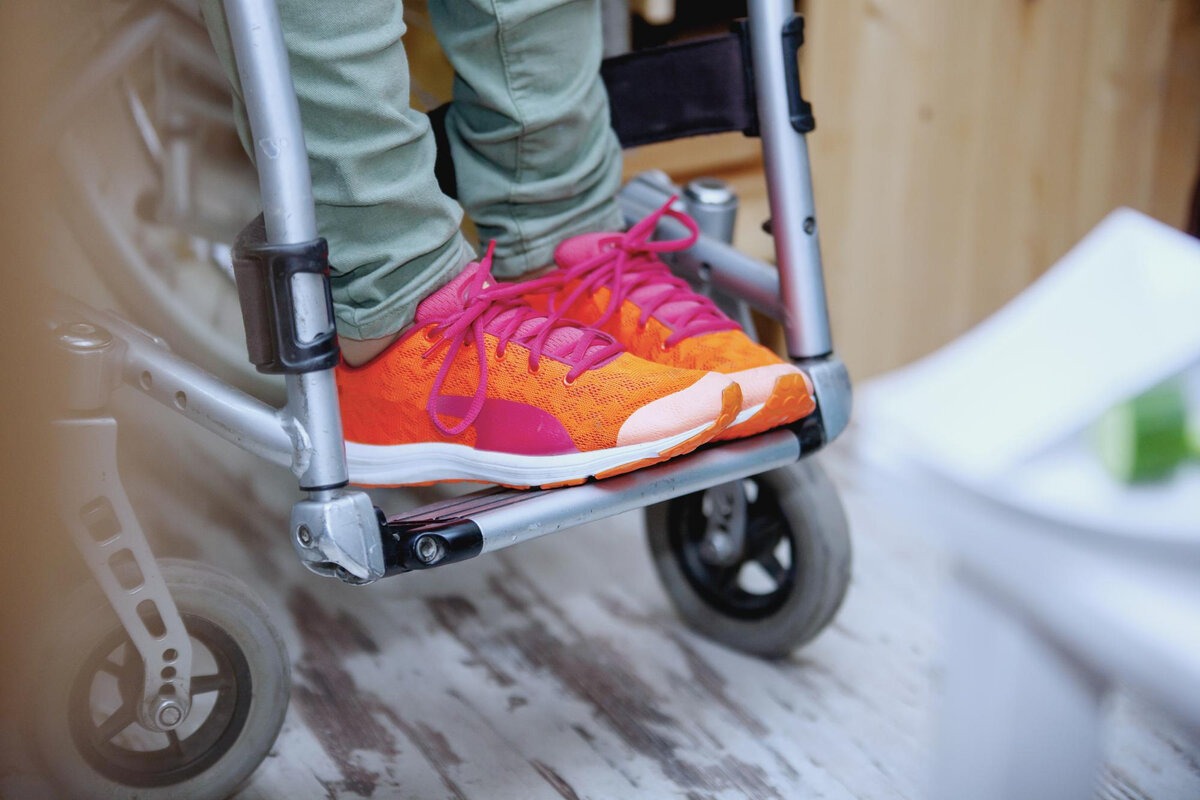
What are standing frames, and what are they for?
What it is. This is a special device that helps a child to take an upright position and hold it for a long time.
What for. The upright posture is considered by nature to be the normal posture for all human beings. It ensures that the load on the feet and musculoskeletal system is distributed symmetrically, so that all muscles and bones develop properly. This is of paramount importance in the case of cerebral palsy, especially when a child has to lie horizontally for long periods of time.
Accessories. There are different types of standing frames: for example, there is a standing walking frame - which is needed for a child to move smoothly and almost without the help of an adult. There's a supine standing frame - so children can sit at the table and keep their backs straight. There is a standing frame walker - with simulated walking, which helps the child fix the correct position of the body during this movement.
Why it is important to use standing frames?
Standing frames are necessary for the rehabilitation of children, especially as they get older. It's difficult for a parent to hold the child upright in their arms because the child is already too heavy. In addition, parents can't always hold the child correctly, and the device provides support from all sides and fixes what is needed.
The standing frame has a positive effect on the development of the vestibular apparatus, strengthens the spine and reduces the risk of skeletal deformities.
There is another implication: the standing frame is not easy to adapt to. It may take time before a child gets used to it. It is harder for teenagers to develop the habit of using a standing frame, especially if they have never seen one before. The younger the child, the easier the adaptation. Results do not appear immediately: the device needs to be used regularly to have noticeable results.
How to choose a standing frame?
You should consult with your child's doctor to choose a 100% suitable standing frame. It is important to consult with the child's doctor about the choice of a standing frame, depends on the kind of cerebral palsy, the severity of damage to brain structures, the child's age, height, weight, and mental development.
We will tell you what kinds of standing frames are available so that it will be easier for you to navigate when buying one if you decide to buy one.
Device type:
Age types of devices:
From 3 to 6 years old;
From 5 to 12 years old;
From 12 to 15 years old.
Before buying, you should take your child to a store to do a test: let your child sit in different standing frames and see where he or she is more comfortable. Sometimes stores will allow you to use the standing frames (as if you were renting them) to evaluate their suitability – check it. Also check how it will be stored, as some standing frames, even very bulky ones, can be folded compactly - this is important in a small home.
It is necessary to consult a medical specialist.
What it is. This is a special device that helps a child to take an upright position and hold it for a long time.
What for. The upright posture is considered by nature to be the normal posture for all human beings. It ensures that the load on the feet and musculoskeletal system is distributed symmetrically, so that all muscles and bones develop properly. This is of paramount importance in the case of cerebral palsy, especially when a child has to lie horizontally for long periods of time.
Accessories. There are different types of standing frames: for example, there is a standing walking frame - which is needed for a child to move smoothly and almost without the help of an adult. There's a supine standing frame - so children can sit at the table and keep their backs straight. There is a standing frame walker - with simulated walking, which helps the child fix the correct position of the body during this movement.
Why it is important to use standing frames?
Standing frames are necessary for the rehabilitation of children, especially as they get older. It's difficult for a parent to hold the child upright in their arms because the child is already too heavy. In addition, parents can't always hold the child correctly, and the device provides support from all sides and fixes what is needed.
The standing frame has a positive effect on the development of the vestibular apparatus, strengthens the spine and reduces the risk of skeletal deformities.
There is another implication: the standing frame is not easy to adapt to. It may take time before a child gets used to it. It is harder for teenagers to develop the habit of using a standing frame, especially if they have never seen one before. The younger the child, the easier the adaptation. Results do not appear immediately: the device needs to be used regularly to have noticeable results.
How to choose a standing frame?
You should consult with your child's doctor to choose a 100% suitable standing frame. It is important to consult with the child's doctor about the choice of a standing frame, depends on the kind of cerebral palsy, the severity of damage to brain structures, the child's age, height, weight, and mental development.
We will tell you what kinds of standing frames are available so that it will be easier for you to navigate when buying one if you decide to buy one.
Device type:
- Static one - a child is fixed in the device, which performs the necessary movements independently. A child is not able to move on his/her own in this standing frame.
- Dynamic one - same as static, but in this standing frame, a child can move by himself, and a device maintains the correct position of the spine. A child moves his legs by moving his arms.
- Mobile one - a device supports a child vertically, and it is possible to move in it with the help of wheels. This type is usually suitable for children who have difficulty moving both arms and legs.
- Multilevel one - in this device, a child can be not only upright, but also in any other position: sitting, lying, half lying, half sitting.
- Front one - a child rests on the stomach when walking.
- Rear one - a child rests on his/her back when walking.
Age types of devices:
From 3 to 6 years old;
From 5 to 12 years old;
From 12 to 15 years old.
Before buying, you should take your child to a store to do a test: let your child sit in different standing frames and see where he or she is more comfortable. Sometimes stores will allow you to use the standing frames (as if you were renting them) to evaluate their suitability – check it. Also check how it will be stored, as some standing frames, even very bulky ones, can be folded compactly - this is important in a small home.
It is necessary to consult a medical specialist.


