
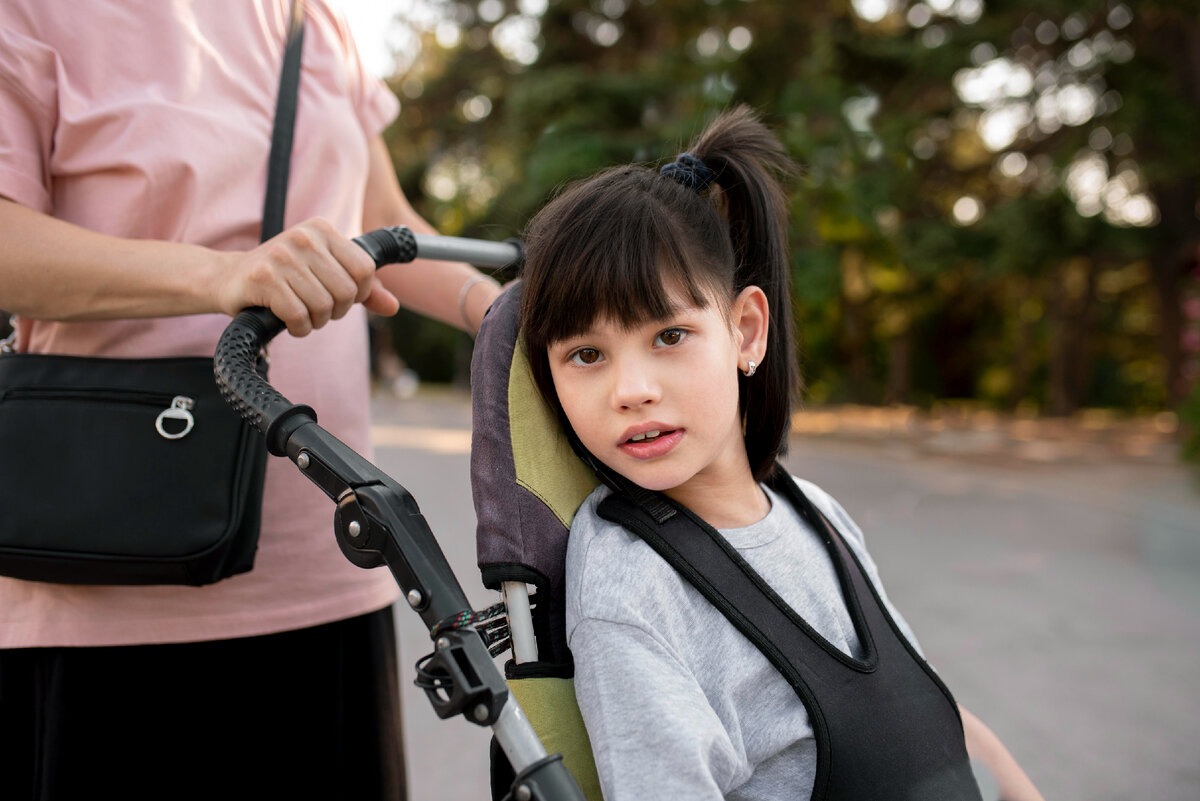
How to sit and what to sit on
What to sit on. A sufficiently firm chair with armrests. The height of the chair should be adjustable and appropriate for the child's height - when the child's knees are bent at 90 degrees, the feet should be fully on the floor, not dangling in the air. This position provides support for a child and allows them to feel the weight of their own body weight. This is important to evenly distribute the load on the spine and to avoid muscle strain. In this way, a child can sit for a long time without getting tired quickly.
There are special orthopedic chairs that partially immobilize the child and help maintain posture and balance. They have headrests - for children who cannot hold their head by themselves - and fixators - pelvic, foot, back and side support. These chairs are typically used by rehabilitation specialists.
What not to sit on. Padded armchairs, sofas and poufs should be excluded: many children with cerebral palsy find it difficult to sit stably on such surfaces.
Here are some exercise options your child can do at home.
A combination of home support and rehabilitation activities is important. One must not exclude the other: a team of specialists helps a child with Cerebral palsy to compensate for impairments and teaches basic skills, while parents reinforce the result. Only this combination will give the best effect.
Check with your child's doctor before using the exercises to see if they can be used - the exercises are not universal and may not be appropriate for all forms of cerebral palsy.
If it is difficult for the child, then you can divide the exercises into several sets and do them with intervals for a short rest.
It is necessary to consult a medical specialist.
What to sit on. A sufficiently firm chair with armrests. The height of the chair should be adjustable and appropriate for the child's height - when the child's knees are bent at 90 degrees, the feet should be fully on the floor, not dangling in the air. This position provides support for a child and allows them to feel the weight of their own body weight. This is important to evenly distribute the load on the spine and to avoid muscle strain. In this way, a child can sit for a long time without getting tired quickly.
There are special orthopedic chairs that partially immobilize the child and help maintain posture and balance. They have headrests - for children who cannot hold their head by themselves - and fixators - pelvic, foot, back and side support. These chairs are typically used by rehabilitation specialists.
What not to sit on. Padded armchairs, sofas and poufs should be excluded: many children with cerebral palsy find it difficult to sit stably on such surfaces.
Here are some exercise options your child can do at home.
A combination of home support and rehabilitation activities is important. One must not exclude the other: a team of specialists helps a child with Cerebral palsy to compensate for impairments and teaches basic skills, while parents reinforce the result. Only this combination will give the best effect.
Check with your child's doctor before using the exercises to see if they can be used - the exercises are not universal and may not be appropriate for all forms of cerebral palsy.
- Bending forward. Parent sits on knees and squats on heels. A child stands with its back to the parent. It is necessary to try to make sure that the child's feet are at shoulder width. The parent holds the child's feet with his hands and a child must sit on the parent's hips and press his back against the parent. Then a parent slowly stands up and leans forward, forcing the child to stand up with this movement. The key is that a child does not roll forward but tries to stand up. This helps the child balance his or her body.
- With a chair. A parent and child face each other. There is a chair behind the child's back. A parent holds the child under the buttocks, presses lightly on the chest, and slowly lowers the child onto the chair. This exercise is necessary for a child to understand what "standing position" and "sitting position" are and what action is needed to move from one to the other.
- With a ball. A parent sits on the floor, and a child sits with his back to the parent between his legs. An inflatable ball is in front of the child. Such as a beach volleyball. As the child picks up the ball with his hands, the parent lifts the ball so that the child assumes a stable sitting position.
If it is difficult for the child, then you can divide the exercises into several sets and do them with intervals for a short rest.
It is necessary to consult a medical specialist.


