
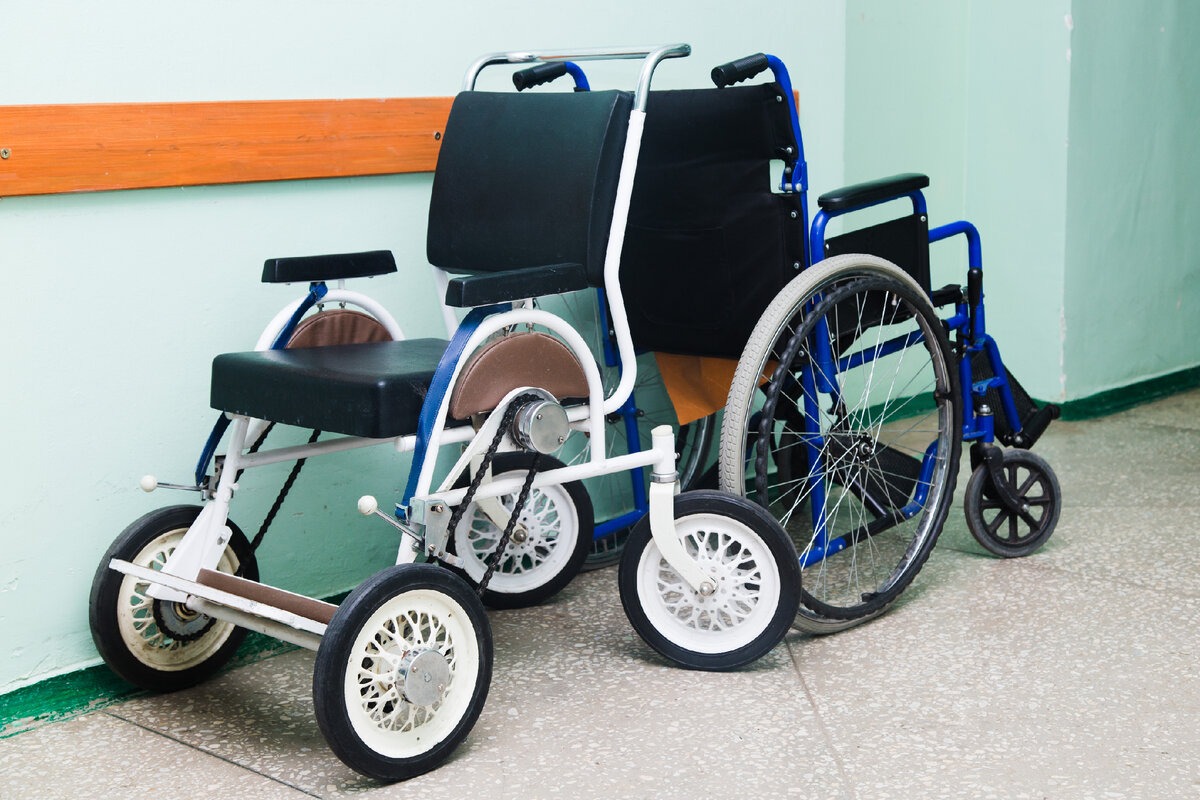
Rehabilitation encourages children with cerebral palsy to walk on their own, but they still need a stroller. Children with motor difficulties cannot walk for long periods of time, even if they are able to do it; they get tired quickly. Once children are over a year old, it is hard for parents to carry them in their arms - but with a stroller, you can walk almost as much as you want.
Rehabilitation specialists say it is better to have two strollers: one at home and the other for walking. Often, a stroller for walking is wider than an indoor stroller; this is done on purpose so that the child can be safely accommodated in a stroller in warm clothes and not sit in cramped conditions. Two strollers are also more convenient for parents: it is not necessary to constantly wash the wheels.
Not everyone can afford to buy two strollers at once. Therefore, doctors recommend focusing on where the child spends the most time. Most likely, at home, which means that an indoor stroller will be on the list of the first necessity and only then a stroller for walking. But you should consider that it has a narrow wheelbase, so in terms of handling on the street, an indoor stroller will be inferior to a stroller for walking.
A conventional stroller is not designed to seat a child with mobility difficulties. It lacks the important details we will discuss below.
How to choose a stroller for a child with cerebral palsy
We do not provide information about powered strollers here because they are not appropriate for everyone. We only talk about those that can be operated by the parent.
Note: You don't have to buy a stroller with all the functions at once; some of them will simply not be useful. In order to get more precise advice on choosing a stroller, you can consult an occupational therapist, a doctor who helps restore motor functions.
So, what to look out for when choosing a stroller?
It is necessary to consult a medical specialist.
Rehabilitation specialists say it is better to have two strollers: one at home and the other for walking. Often, a stroller for walking is wider than an indoor stroller; this is done on purpose so that the child can be safely accommodated in a stroller in warm clothes and not sit in cramped conditions. Two strollers are also more convenient for parents: it is not necessary to constantly wash the wheels.
Not everyone can afford to buy two strollers at once. Therefore, doctors recommend focusing on where the child spends the most time. Most likely, at home, which means that an indoor stroller will be on the list of the first necessity and only then a stroller for walking. But you should consider that it has a narrow wheelbase, so in terms of handling on the street, an indoor stroller will be inferior to a stroller for walking.
A conventional stroller is not designed to seat a child with mobility difficulties. It lacks the important details we will discuss below.
How to choose a stroller for a child with cerebral palsy
We do not provide information about powered strollers here because they are not appropriate for everyone. We only talk about those that can be operated by the parent.
Note: You don't have to buy a stroller with all the functions at once; some of them will simply not be useful. In order to get more precise advice on choosing a stroller, you can consult an occupational therapist, a doctor who helps restore motor functions.
So, what to look out for when choosing a stroller?
- Size. The most important measurements to take are the dimensions of the front doorway, elevator, and access door openings. A stroller should fit freely through all three.
- Transportation. Usually, strollers are folded to make transportation easier. The most common types are umbrella stroller and book stroller. The first one folds as if lengthwise and thus takes up less space. It is lightweight and compact, but it is limited in equipment and not very stable. The second one folds across and is bulkier, but it can have a maximum number of options and adjustments. Everything depends on the child's condition - if the cerebral palsy is conditionally "mild", an umbrella stroller is probably preferable, as the child does not need many settings and functions.
- Fasteners. There are children who assume incorrect and unnatural positions when sitting - for them, there are fixings that gently fix the child in an adequate position. It is important because, without fixings, children can accidentally hurt themself—for example, dislocate the hand. This also includes seat belts that prevent the child from falling out.
- Adjustment. The elements of the stroller should be adjustable to "grow" with the child and adjust to changes not only in height but also in the angle of inclination: footrest, seat, and backrest. It's good if the seat has additional adjustment in width and depth, and the backrest should be rigid and reclining for those children who find it difficult to sit with a straight back for a long time.
- Support. This is not important for all strollers, but it is an important point: a stroller should have support for the head and legs. This is not only necessary for children with cerebral palsy but also for healthy children. With the support, the child's head will be located in a natural position, and the eyes will look directly at the world. The legs on the footrest provide boundaries and stability. No one is comfortable with their feet dangling in the air with nowhere to put them; if this goes on for long, they can become sore and stiff. When children feel the support under their feet, they are much more comfortable in the stroller, and walking does not create negative associations.
- Abductor. It is necessary to prevent the child from bringing the legs together and ensure a correct position. It must be located between the child's knees. Furthermore, it is believed that an abductor helps children not to slip out of the stroller, but this is not true. If the abductor is constantly resting on the crotch, it can cause genital irritation. There is a rigid abductor and a trouser abductor; the choice depends on whether children bend their back when sitting. If so, the rigid version is most likely to be appropriate.
- Wheels. Two types of wheels are available: solid and pneumatic. The first is made entirely of plastic tires; these types of wheels are hard on the move but durable and unbreakable. The second is similar to bicycle tires and is softer, but it can be accidentally punctured. Select depending on your child: if you realize that he or she has high sensitivity, it is better to look at pneumatic wheels.
It is necessary to consult a medical specialist.


